

|

|

|

|

|
|
|
|
....
....
Who was Buddha?
There is much information, and many website’s that provide information about Buddhism. The aim of this short piece is not to provide extensive information regarding Buddhism, or aim to promote it above any other belief or philosophy; but merely to provide an introduction to the philosophy.
For further information regarding Buddhism, links are provided throughout this site, and also on the links page. Here is only a brief outline on this subject. I feel that, without the inclusion of this great philosophy, the aim of this website would be wholly incomplete.
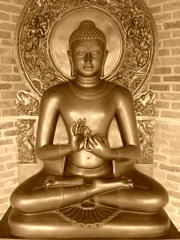 The Buddha, [or the most well known Buddha], was a Hindu prince called Siddhartha Gotama, or Gautama, who was born to a royal family in the 6th century BC. He was born in Northern India, in a place called "Lumbini", [now located in Nepal], and was son to the king of the Sakya, a warrior tribe. Thus Buddha was also known as "Sakyamuni", which means "Sage of the Sakyas".
It is said, that at the time of his birth, there were many signs, and that a sage predicted his destiny to be either that of a great king, or a great spiritual teacher. This revelation in itself, should not be much of a surprise, given that the child was already born into royalty; also a spiritual teacher would aspire to being, if not of equal to a great king, a position of even more importance.
His father, the king, wanted his son to become his successor, so guarding the words of the sage, he proceeded to protect his son from any inclination toward a spiritual career. So the prince spent much of his life within the walls of his father’s palace. He was said to be both intelligent, and athletic, and he later married, and had one son. Yet, when his son was still very young, he took a disguise, and ventured out into his city, whereupon he witnessed the reality of poverty and hardship amongst his fellow citizens. It was this discovery of suffering and hardship that lead Gautama, now almost thirty years of age, to turn away from his home and his life of luxury, and embark upon a spiritual quest - leaving his wife and young son behind.
His goal was to seek a spiritual path, that would lead to the end of suffering.
Taking only simple clothes and supplies, he ventured out from his palace and sought a path of spiritual teaching and enlightenment. He studied under various spiritual teachers, the first being Alara Kalama, who taught him a way of meditation and release, called the "state of nothingness". A meditative approach to separate the conscious thoughts of his troubled mind, and enter a place of peace within. His next teacher was Udraka Ramaputra, who taught a meditative technique that lead to "a state of neither perception nor non-perception". Both these teachers were said to "Jains", or followers of Jainism; an ascetic form of spiritual teaching, that pre-dated Buddhism.
He continued on his journey of meditation and asceticism, for six years. Believing at first, the path to spiritual enlightenment, must include sacrifice of personal comfort, possessions, and fasting, Gautama continued until he could take no more, and almost died of starvation. He realised the form of extreme asceticism he was practising was only leading to self destruction, and lead him to no new revelation or enlightenment.
It is here, that he left his spiritual teachers and followers, in search of some other method or means to his truth. He travelled to a place called "Bodhgaya", and there he sat beneath a "Bodhi" tree, [date tree]. He sat there and vowed not to move until he had reached a place of truth and understanding. It is here that Gautama finally found enlightenment, beneath the Bodhi tree. His meditations finally found him the truth he was seeking, and the rest, as they say, is history.
It is believed that Gautama had become enlightened to the cause of suffering, and of the human condition, seeing at once, the state of all beings alive, and in death and rebirth. His meditations had showed him the cause of suffering and pain, and also a path to liberation, and freedom from it. Gautama had finally become a Buddha, or "awakened one".
Whilst remaining beneath the Bodhi tree, it is told that the Buddha was tempted by the demon "Mara", who sent his three beautiful daughters to distract the Buddha from his meditation. When this failed, Mara then sent an army of devils to destroy him, yet this also failed. Finally, Mara tried his own hand at destroying the monk, but even this failed to distract the Buddha from his meditation.
He continued in his meditations for seven more days, and stayed near the Bodhi tree for several more weeks, before returning to his ascetic followers that he had left behind. There he told them of his enlightenment, and shared with them his visions, and revelations for Buddhahood. These five ascetics were his first converts, and soon after, at the deer park in "Benares", Buddha Gautama preached his first sermon on the "Four Noble Truths", and the "Eight Fold Path" that leads to salvation. His followers soon grew in numbers, known as the "Sangha", they included Gautama’s cousin Ananda, and later his son Rahula.
The Buddha became enlightened in his 35th year, and spent the remaining 45 years of his life, travelling and teaching his doctrines up and down the "Ganges", to any who chose to listen. He was said to be compassionate to all, and catered for the understanding and teaching of both the wealthy and poor, the intelligent and the less so. He was revered for his patience and understanding, and Buddha nature. Many of his converts were kings and royalty and the wealthy, and there are many stories relating to his conversion of these prominent characters of his time.
His "Sangha" did not exclude women from his order, and as well as his monks, "Bhikku", he encouraged an order of nuns called , "Bhikkhunis". Buddha held great respect for women, and their virtue. There are many stories that include the wisdom and praise of women both within his order, and converted to his following, however, the Buddha himself, renounced any temptation and desire for relationship.
Buddha was also not without his enemies, and it is told that he survived several assassination attempts. However, his enemies appeared to have been few, and at length, even became his followers. It is said that he performed miracles, and had psychic powers, and that he tamed wild elephants, and even walked upon water. However, the Buddha was the first to dissuade any real importance to his feats, instead placing emphasis on his doctrines, ethics and "middle way".
When the Buddha reached his 80th year, he felt weary, and that his days on Earth were drawing to a close. He decided to visit all his outlying monasteries one last time. Even now, many of the Buddha’s most elder disciples had already passed away. He was still accompanied by his young cousin Ananda, who had spent 25 years faithfully at the Buddha’s side, when he finally returned to Northern India, to a small village called "Kusinaga", whereupon, he settled to spend his final peaceful days.
It is told, that the Buddha’s last meal was with a party of his disciples at Pava, where he took invitation from the local blacksmith, who provided a meal for them. It is told that Buddha requested that he alone, should be served by the blacksmith, and that his food should not be shared with the rest of his party, but rather, they should be served and eat as separate. He told the blacksmith, "Cunda, if any sukaramaddava is left over, bury it in a hole. I do not see anyone in the world other than the Blessed One who could digest the food if he ate it."
The Buddha praised his host for the meal, and spent time with him, and taught him the "Dharma". However, he became very ill, and in pain. He decided at once to return to Kusinaga, only a short distance, and settled outside the village, near some Sala trees. The Buddha took a last bath in the river, "Kakuttha", and asked Ananda to prepare a hammock between the trees. It was clear that the Buddha would pass his final hours here.
He told his party, "Now it may happen that some people may make Cunda regret having given me the meal that made me sick. Ananda, if this should happen, you should tell Cunda that you have heard directly from the Buddha that it was a gain for him. Tell him that two offerings to the Buddha are of equal gain; the offering of food just before his supreme enlightenment and the offering of food just before he passes away. This is the final birth of the Buddha."
"Now you can go, Ananda. But go into Kusinaga and tell all the people that tonight, in the last watch of the night, the Buddha will pass away into nirvana. Come and see the Buddha before he passes away."
It is said that many came that night to pay homage to the passing Buddha, and that he still found time to spend with any who needed his guidance. Buddha Gautama passed away and into final "Nirvana" during a moonlit night in May, 483 BC He was aged 80 years. His remains were later cremated.
Buddha left no successor to lead the "Sangha", but rather encouraged all his monks to continue in preaching the "Dharma" and doctrines. Throughout his last year, he repeated his teachings on the "Vinaya", the discipline of the "Sangha". He inspired his monks with the confidence to continue in their path, and to the teaching of all who would wish to listen.
The Buddha Gautama never professed to being a deity, or a prophet. And although his enlightenment, wisdom and compassion are without contradiction or measure, he never claimed any special reverence or praise, and remained humble, even in the presence of temptation, hostility and ridicule. It is without doubt, he is one of the most influential and important figures in human history, and history of humanity. Even for those who may follow other doctrines and religions, his philosophy of peace and compassion serves as a reminder of the possibilities and potential of humanity. And it should be noted also, that there has never been a single war or conflict consociated with the name of Buddha.
More information and stories on the life of Buddha Gautama can be found here at Buddhanet


Back to contents..