

|

|

|

|

|
|
|
|
....
....
Universal truths & Classical laws - Part one
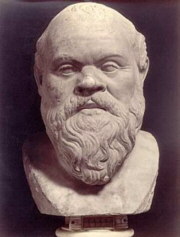 As far back as the 5th century B.C, Socrates and the Sophists argued that sensibility and the senses could not be trusted to provide truth and understanding of the world around us. And for this reason the Sophists declared that the pursuit of knowledge and universal truth was misguided, and that man should strive to live according to his limits, and concentrate on the advancement of himself rather than pursue that of which he did not know, and could not possibly comprehend. Thus the words of Protagoras - "Man is the measure of all things". Another great Sophist, Gorgias, went even further declaring, "Nothing exists, and if it did, no one could know it, and if they knew it, they could not communicate it". Instead the Sophists promoted a philosophy of life, and non reliance of knowledge, but rather the development of humanity, and communication. Rather like the contemporary ideas of emotional intelligence and social development.
Whilst Socrates concurred with the notion that senses were unreliable, he by no means agreed with the Sophists, and was rather troubled that the advancement of mankind could be so blind as to ignore knowledge and truth, which has the potential for total disaster. He did however, come to the reasoning that man could not possibly learn any universal truth at all, because of the unreliability of his senses. Therefore he deduced that to learn the truth was misguided, as there existed no measure or yardstick by way of testing this truth, therefore in the end, no real declaration of this truth or otherwise.
In other words, Socrates reasoned that if you did not know the truth already, how could you possibly hope to learn it, as you would still not be sure it was the truth in the end?
He therefore came to the deduction, that any universal truth, real truth, already existed inside all of us. He used a demonstration for this; the ‘Meno’ - in which he uses a slave boy, who has no prior education in arithmetic or geometry, and by way of questioning only, helps the boy arrive at a mathematical truth for himself, and thus help prove his own point that the truth was already inside, in this case by way of reasoning.
In the ‘Meno’, Socrates draws a square of sides 2 feet in length, and then asks the slave boy, "What would be the length of sides of a square with twice the area?" The boy immediately answers, twice as long, but Socrates answers, "no that is wrong", and continues to quiz the boy about the squares and areas. Sure enough, (with a little encouragement?), the boy arrives at the correct answer eventually, that being the area of eight feet is calculated from the diagonal line inside the square. This demonstration indicated that the logic reasoning, and truth of this question was already inside us, without the need to learn it on a blackboard.
Like counting fingers, one is taught how to count, or rather the words to signify counting, as a young child, but the reasoning and comprehension of the counting of fingers is already inside our minds. Think back, if you can, to the time when you were taught this yourselves, or if you cannot remember, try to imagine you were again a child being taught this for the first time. The revelation of truth that came when you were first taught that 1+1=2, and that 2+2=4.
Plato, who was the pupil of Socrates, took this idea of universal truth even further, and himself reasoned that if this type of truth and understanding could not be learned, but was rather already known to us, even from a very young age, then it must have already existed before hand in the spirit mind, or the soul. The spirit of an unborn child! A radical thought indeed, that before we are even born, within us there lies universal truth and understanding of classical laws, like the example of arithmetic above.
Socrates proposed a way of attaining the truth that exists in all of us, by way of method and use of arithmetic, geometry and solid geometry, (study of third dimensions and planets), to finally attain a level of inner truth he termed the ‘dialectic’. Like a Confucian ideal, Socrates proposed that until man was governed by philosophy and truth, or ruled by a leader of philosophy such as this, his evolution would be hindered.
It is interesting to note that the great 17th century French philosopher and mathematician, Rene Descartes, also reasoned for this universal, pure truth, by way of rejecting anything that could not wholly be accepted as true. His goal ultimately failed, as he was forced to reject everything he could not verify, without doubts, that were not eternally true. This lead Descartes to the reasoning that not even reality could be judged as true, and therefore that the dream at night, may be just as real as the dream by day. That the objects and things we witness in our dream worlds, may be just from our imagination, because we could not possibly rely on senses alone to show us the truth of the physical world, (or the dream world?).
Plato’s 'Meno' is the record of a discussion between Socrates and a young man from Thessaly named Meno, in the presence of his boy slave, and a wealthy aristocrat named Anytus.
For details of the dialogue see here - Plato's 'Meno'