

|

|

|

|

|
|
|
|
....
....
Plato ~ Forms and ideas
Socrates was one of the great Athenian philosophers who debated the origins of truth and virtue. His student and pupil was yet another great philosopher called Plato.
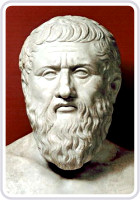 Plato lived in Athens between 427 to 347 BCE, his real name was Aristocles. He was keen to record his writings for posterity, and for future generations. For this we truly must give thanks to Plato. Not only did he faithfully record his own works, but he recorded the dialogues of his master Socrates, who actually never wrote a word down for history. It is from Plato's dialogues that we indeed know anything about Socrates and his thoughts and ideas.
Plato, on the other hand, formulated some very profound ideas of his own, which contemplated everything from ethics to politics, to science and metaphysics. It is his metaphysical ideas that we are concerned with here, and the conclusions that Plato drew from the former contemplation's of Socrates, Democritus and Heraclitus.
Plato reasoned for an underlying eternal truth, as did his master Socrates. Plato thought about the questions and problems faced by his contemporaries, regarding the natural world about us, the world we perceive with our five senses. He agreed with the former conclusions that the world is filled with imperfections and change, or in other words, the world was in a constant state of flux.
This state of change was symbolised by the imperfections of everything around him, from flowers to trees, to animals, to man himself. Yet regardless of this range of differences and imperfections between them, one could quite clearly observe the identities of these items without any difficulties; for example, one could tell one flower from another, and the differences between all animals, regardless of their species or coloration.
Through his reasoning, and love of geometry and mathematics, and their inherent truth therein, Plato came to deduce that the imperfect world that we perceive around us is just a carbon copy of another reality, or higher world of ideas and truth. He drew from the conclusion that the imperfect could not derive from the perfect. Like the truth of geometry and mathematics is immutable and can only be known by insight, and cannot be reached through learning, then, so to, the world of things must be derived from a higher source, a world of perfect forms.
This, in short, lead Plato to believe that all things in nature were formed from a template, an eternal pattern that dictated the appearance of a certain thing in our natural world, the world of appearance. These templates, he termed as 'ideas' and 'forms', that were both perfect and immutable, for they had to be so, he reasoned. Else eventually, any flower that did not hold to this ideal pattern, would become some thing entirely different eventually. It was the eternal pattern, that held the rose to be a rose, and not a daisy. We may liken this revelation in our present times to our knowledge of DNA and genetic structure and information. Yet Plato went even further with this reasoning, and concluded that man, himself, was constructed from this same immutable scheme. That man had an immortal soul that existed beyond his worldly state, and that his soul was held between the realm of perfect forms and ideas, of truth, and God; and between his mortal existence on Earth, a world of appearance and impermanence.
Yet how were these seemingly dual realities of 'form' and matter related?
For Plato, the answer to the question lied between an understanding of the world of perfect ideas, and the natural world of constant change. Somewhere in between there was a bridge between immutable truth, and this state of flux. This bridge or catalyst, he called the 'Demiurge', a divine agent whose purpose was to create and form the shapeless chaos of matter, from souls, with their perfect 'ideas' of the creator. Whether by purpose or just ignorance, the demiurge was destined to create inferior and imperfect imitations of the true 'form' and 'idea' of creation, and thus created a world of appearance and constant change that is inferior to the true pattern of the higher existence, that was true to God.
Whilst Plato's ideas may seem somewhat naive today, his metaphysical suppositions had a profound affect on theology and religions, including that of Judaism, Christianity, and Gnosticism, as well as other religious beliefs that followed these. His writings inspired a whole new theological movement of Neo-Platonism, that prescribed to an understanding of man and his relationship with God.
So where does this thing called the mind, the spirit, the soul originate?
Even in ancient Greece, philosophy was challenged with the ideas of creation and the origins of mankind; and of the understanding of his intellect and his knowledge, and his soul. The new age of Athenian philosophy discouraged the reliance on the Gods for answers to man's origins and nature. Greek mythology held that man's destiny was prescribed by the Gods, yet, even so, man had a certain displacement for freewill, that could both defy and aggravate these Gods. Many a Greek myth tells of a heroic figure who brings down the wrath of the Gods of Olympus, yet gives him a level of authority for his own destiny and existence.
For the 'form' in Plato's model to exist, he reasons there must first be an 'idea' of the form. This 'idea' is the prime mover, or creator's thought. That is, it is precisely the notion and creation by God that gives rise to an eternal and immutable 'Form'. This would make logical sense, as nothing can really be perceived before it is first brought to mind. The perfect 'idea' must therefore give rise to the perfect 'form', or template. This thesis in itself has provided the basis for such philosophies as 'Idealism', and also subscribes to 'monism', or a belief in a single God and creator. It is no wonder that Plato's ideas have found their way into Judaism and Christianity, with his preconceptions for perfect creation and a single perfect God.
Plato believed that the soul of man, being eternal, and born of truth and from the perfection of God, was lost to the world of ideas, from re-birth into a mortal body. Yet, through the experience of the world of appearance, and the senses, the soul becomes aware of the underlying existence of a world of perfection, and of ideas and forms. There upon, the soul becomes unhappy in its imprisonment as a mortal being, and transcends to look upon the world of ideas, and search for the truth. This yearning for truth and knowledge, Plato called 'Eros', (which also means God of love).
Plato's analogy of the cave gives us an understanding as to his thoughts about the existence of the realm of ideas and the world of appearance.
In his example, he gives us a story of prisoners tied and bound in a cave, where upon they cannot turn their heads, and are imprisoned to face the wall of the cave in front of them. The cave wall they see is alive with shadows, shapes and movements, that are cast from a real world that exists behind the prisoners, of which they cannot see or perceive. There is a fire behind the real world objects, symbolic of the Sun, which casts these shadows and movements in front of the prisoners.
The shadow world of existence is all that these prisoners know, until that is, one of the prisoners breaks free and ventures out from the cave and sees for himself the real world and the real truth beyond. He casts his weary eyes upon all the wonders of the world, and the colours of nature, and strains to see the blinding reality of the Sun and heavens. Enlightened, the man decides to return to the cave to tell his fellow prisoners of the revelation and to describe to them what he has seen, and the real world that is yet still unknown to them. Unfortunately, they do not understand, in their ignorance of beholding only shadows, and reject him as mad and fanciful, continuing instead, to live their lives watching the shadows on the wall.
This story also serves as a metaphor, not only for man's ignorance of the understanding of nature and the world around him, but moreover, for his arrogance in refusing to open his mind to the possibilities of that which he cannot readily see in front of him. In this case, the metaphysical ideas that Plato is attempting to describe.
With hindsight, we may say that Plato's notions of forms and appearance is flawed, because, according to his reasoning, the perfect 'form' is eternal, and exists separate of the representation of it's imperfect replication. According to Plato, the 'form' exists whether the thing itself exists in the world of our perception or not, which contradicts our everyday experience of evolution and history. For example, the extinction of animal species such as the Dodo, and dinosaur, and even man's earliest ancestors. True, the 'form' and 'idea' may still exist, but in reality, the Dodo cannot come back from the dead, even though we may have recorded and remembered it's perfect shape and form.
This is how later, the great philosopher Aristotle came to disagree with the ideas of Plato. Aristotle was very keen on observing nature and recording it's details and differences. Categorising species himself, he concluded it was this ability of man to observe and systematically categorise, that governed his understanding of the world, and to therefore recognise and understand, through sense experience, the different forms around him. Aristotle believed, that the eternal template, Plato's form, existed within the subject itself, as an inherent knowledge and potential for the thing itself to transform, and change, and grow. A very clever insight indeed, that points to what we now hold as true - genetic code, and DNA structure. Aristotle pioneered the way forward for the importance of accurate records, and logical examination, which then paved the way towards the scientific approach and method of finding truth.
Yet despite the dawning of the scientific age, and that of logical reasoning, that shunned the metaphysical ideas of Plato and his peers; the mysteries of creation and of the soul of man remain unanswered to this day. We are still no closer now to any scientific proof of the origins of life, than we were back then. And who knows, we may never have really investigated this phenomena in such detail if it were not for Plato and his former philosophers, some 2,500 years ago.