

|

|

|

|

|
|
|
|
....
....
Mind and Body - Descartes
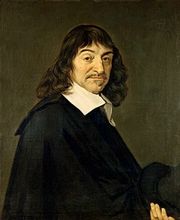 The great French philosopher, Rene Descartes, [1596 -1650], also embraced the pursuit of ‘Truth’ in the same way that Socrates and Plato had previously examined. By using reasoning and logic, Descartes absorbed himself with the pursuit of an unquestionable truth, and sought to solve the mysteries of the mind and the body, and the connections between thoughts and senses, and the external world of extended material forms.
Just like the ancient Greek philosophers, he sought to find the relationship between the mind and the body, and set out to reason how the material world and the world of ideas interacted with each other - How the material process of the brain connected to the thought process of the mind.
The great French philosopher, Rene Descartes, [1596 -1650], also embraced the pursuit of ‘Truth’ in the same way that Socrates and Plato had previously examined. By using reasoning and logic, Descartes absorbed himself with the pursuit of an unquestionable truth, and sought to solve the mysteries of the mind and the body, and the connections between thoughts and senses, and the external world of extended material forms.
Just like the ancient Greek philosophers, he sought to find the relationship between the mind and the body, and set out to reason how the material world and the world of ideas interacted with each other - How the material process of the brain connected to the thought process of the mind.
Descartes did not exclude a divine creator in his views and beliefs, and concluded that the Universe and all things were comprised of either God, Mind or Matter, which he termed substances. His goal was to find the relationships between these, and in so doing, find the ultimate truth and reason in all things. A noble quest indeed. Yet the mission may have been almost too impossible from the start.
Descartes was a highly successful and influential figure in his time. Being both a scientist and mathematician, He played a key role in the new "scientific revolution", that had risen from the reformation of the Roman church, and man’s new quest for independence and pursuit of natural, and physical truth. He had already formulated the "Cartesian co-ordinate system", as used in Geometry, as well as Algebra. So it was only natural for Descartes to embrace philosophy also. He has been posthumously given the title, "Founder of Modern philosophy". A grand title indeed, and the reason for this is apparent - Descartes had opened, [or re-opened], the proverbial "can of worms", in his quest for the absolute truth. His writings have been debated and argued amongst many great philosophers since, and to this day, his ideas and thoughts, and reason is still a foundation for the philosophy of rationalism, [although he had many critics in this field of philosophy].
Even before embarking on a career into science and mathematics, Descartes’ interest in philosophy was obvious. It was perhaps his destiny, in having such an objective mind and character, and such a clearly defined ideal of truth and reason. His success in the field of mathematics only supported his ideas of the truth in nature, or natural truths.
Method was the foundation of Descartes reasoning, and he thereby set out to find truth through reason, and logic, by eliminating anything he could not definitely confirm as true. The basis of his search for unquestionable truth, was therefore, to remove all doubt, or to seek to find that in which there was no doubt. He termed this method for definition as "Methodlogical scepticism".
His quest soon lead him to the same conclusions as the previous great philosophers, that being, that his senses could not be trusted to provide the whole truth regarding objects in the external world about him. He reasoned that the body was an extended form, made from matter, and that it acted such as a machine, in that it had motion and responded from instructions of the mind. The senses were the means whereby the external world could be experienced by the mind. He reasoned that somewhere in the brain, the information from the extended world of matter is transformed into thoughts in the mind. The mind then acts upon these thoughts in the form of ideas.
He reasoned that, because he was not in control of these sensory perceptions that came to his mind freely, then, there must in fact be an external overwhelming reason, or power, in control outside his own mind - this power, he concluded, being that of God. He also attributed the reason for his senses and the reason for his ideas, to God. In his belief he added, that God would not act otherwise, unless in a totally beneficial, or benevolent manner. In other words, his ideas regarding God’s interaction with the external world and his mind, had purpose, and in that purpose was good intention.
This upset the apple cart once more. For why attempt to logically define the world of extended form and mental thought, through reason, and then introduce God to answer a ‘reason’ for everything?
"Meditations on first philosophy" was first published in 1641, and is subtitled, "In which the existence of God and the real distinction of mind and body, are demonstrated". Therefore Descartes affirms from the very beginning his belief in God, and an underlying intention of God to interact with nature. The book contains six chapters in which Descartes first sets out to show that his senses cannot be trusted to confirm absolute facts about the extended material world - commonly known as Descartes’ scepticism.
After casting doubt on all things, he then proposes a method to analysing what can be accepted as fact. He proposes that because the mind and thoughts are separated from any material world, that the mind can only comprehend anything outside of itself in the way of ideas. That these ideas are not necessarily connected with the extended world at all, and that our thoughts and perceptions are therefore governed by experience and memories within our own mind. He considers that he may in fact, be deceived by an external force or being, [demon], that aims to delude him with such ideas. Yet this leads him to the deduction that, regardless of what may not be true, or may not exist, his notion or idea of his own identity, or psyche remains the only sure thing within his mind. Thus he draws the conclusion, "I am, I exist", or "I think, therefore I am" - despite any other deceptions that are around me.
But what then am I? A thinking thing. And what is that? Something that doubts, understands, affirms, denies, wills, refuses, and also sense and has mental images. (Descartes, Meditation II: On the Nature of the Human Mind, Which Is Better Known Than the Body).
If our sensory perceptions cannot be trusted to define even ourselves, then maybe I am simply the sum of my own ideas, my own psyche, and therefore all I am, is a summation of all I think?
1. The Meditation of yesterday has filled my mind with so many doubts, that it is no longer in my power to forget them. Nor do I see, meanwhile, any principle on which they can be resolved; and, just as if I had fallen all of a sudden into very deep water, I am so greatly disconcerted as to be unable either to plant my feet firmly on the bottom or sustain myself by swimming on the surface. I will, nevertheless, make an effort, and try anew the same path on which I had entered yesterday, that is, proceed by casting aside all that admits of the slightest doubt, not less than if I had discovered it to be absolutely false; and I will continue always in this track until I shall find something that is certain, or at least, if I can do nothing more, until I shall know with certainty that there is nothing certain. Archimedes, that he might transport the entire globe from the place it occupied to another, demanded only a point that was firm and immovable; so, also, I shall be entitled to entertain the highest expectations, if I am fortunate enough to discover only one thing that is certain and indubitable.
Descartes then continues to reason for the truth within the ideas of the mind itself. Surely, any thing that is extended in the outside material world can deceive us, for example, nothing is perfect, we may see different colours or shades of colour from each other, a simple deception from our senses. Yet we may all agree to allow for these imperfections in objects, or rather our errors in perceiving them. So what may be deduced as wholly true, must in fact, be excluded from the extended material world outside our minds. And counter-wise, what we must seek as truth must be within the mind, the idea of perfection, that is common to each and all of us as human beings, or is common in our psyche.
So far, so good, and still no more than had already been deduced by Socrates, Plato and much of the thinking in ancient Greece. In fact, once again, the idea and comprehension of numbers and counting, [arithmetic], and geometry, once more take front stage for the examination of truth, and the idea of truth. Once again, it is the characteristic of the mind to comprehend the idea of numbers and counting, that provides evidence that the mind holds unquestionable truth. Descartes agrees that the realisation of numbers, counting and arithmetic is proof of unquestionable truth, for each and all of us, within our minds. That this realisation is free from doubt, and a common property of the mind. Yet he also goes on to examine the purpose behind this phenomena.